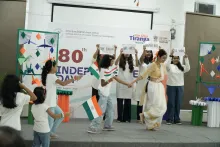
NIFT Bhubaneswar celebrated Handloom Week by bringing together tradition, craftsmanship, creativity, sustainability, and contemporary fashion. The week-long celebration engaged students with India’s rich handloom heritage through discussions, workshops, demonstrations, competitions, and fashion activities.

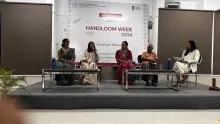
Panel Discussion – 05 August 2026: The celebration began with a panel discussion featuring Ms. Lipsa Hembram, Dr. Anita Sabat, Ms. Shashirekha Mohanta, and Shri Surendra Ku. Patra. The session explored the cultural significance, challenges, and future of handloom textiles.
Mr. Ravi Prakash is an Assistant Professor in the Department of Fashion Design at NIFT Bhubaneswar, where he joined as an Assistant Professor in 2021. His teaching and professional expertise includes garment manufacturing, merchandising, retail, pattern making, sustainable product development, and the design and development of Indian apparel. He holds a B.Tech. in Electronics & Communication Engineering and a postgraduate qualification in Fashion Technology from NIFT Delhi.

Ms. Arpita Misra is an Assistant Professor in the Fashion and Lifestyle Accessory Design Department at NIFT Bhubaneswar, specialising in Home Décor and Lighting Design. She joined NIFT in 2021 and teaches Design Fundamentals, 3D Product Sketching and Rendering, Form Studies, and Design Process-based Projects. She previously served as the Centre Coordinator of the department from 2022 to 2025.

Mr. Gokulrajaun M is an Assistant Professor in the Fashion & Lifestyle Accessories (F&LA) Department at the National Institute of Fashion Technology (NIFT), Bhubaneswar, where he joined the institute in October 2021. Since 2025, he has also been serving as the Centre Coordinator (CC) for the Fashion & Lifestyle Accessories Department, contributing to academic planning, curriculum coordination, and departmental administration.

Vidhi Nagar is an Assistant Professor in the Fashion & Lifestyle Accessories Design Department at NIFT Bhubaneswar. She has over 12 years of professional and academic experience in design practice, product development, craft-based innovation and design education. She holds a Bachelor of Design (B.Des.) and a Master of Fashion Management (MFM) from the National Institute of Fashion Technology (NIFT), where she graduated with a Gold Medal and was recognised as the Student of the Year during her postgraduate studies.

Prof. Binaya Bhusan Jena is a Professor in the Department of Fashion Management Studies (FMS), specialies in sustainable fashion, global sourcing, international marketing and economics. He teaches post graduate and under graduate course at NIFT and also teacher "Research Paradigm" to PhD scholars. He joined NIFT Gandhinagar in 2005 and then transferred to NIFT Gandhinagar in 2010. He has previously served NIFT at various capacities as Director (I/C) and Joint Director (I/C) of Bhubaneswar Campus. He has received his PhD from the Jawaharlal Nehru University (JNU), New Delhi

Bornali Das is an Assistant Professor in the Department of Fashion Communication at the National Institute of Fashion Technology (NIFT). She is a design educator, researcher, and branding strategist with over 12 years of professional and academic experience in branding, communication design, product design, packaging, and visual storytelling. Her expertise spans brand identity systems, design strategy, semiotics, user-centred design, and experiential communication.

Dr. Sulagna Saha is an Assistant Professor in the Department of Fashion Technology (NIFT), Bhubaneswar, specializing in product development, pattern making, and merchandising. She holds a Ph.D. in Sustainability Studies from XIM University and a Master's in Fashion Technology from NIFT.

Mr. Gangadhar Malik is a an Assistant Professor of Fashion Technology  and specializes in apparel production with material & process optimization. He teaches undergraduate and postgraduate courses and leads research in apparel engineering. He joined NIFT in 2008.He previously worked in Apparel Industry in the area of production  & engineering .